Once upon a time, in the infinite land of dreams, there was a kingdom hidden beneath all the others. There was nothing unusual about it, except that it was inhabited only by rats.
This kingdom was much like our own world. There were mother rats, father rats, and child rats; rat villages and rat towns; borders between regions. Rats were born, and rats died. There were famous rats and lesser-known ones. There were deceitful rats, and there were even honest rats. But every rat was working.
What defined this rat world was its motto: “Stand out however you can, but stand out!”

Among them, however, was an old, lazy, and crafty rat who had spent his whole life trying to stand out. He had never found a way to live up to the motto.
As his life was drawing to a close, and he had only a little time left, an idea finally came to him. “If time is so precious, why not chase it down and capture it?”
He invented a trick: a box for storing minutes. Crude in appearance, it was made of baked pulp. He had even scorched it slightly on purpose.
In every public place, he put up posters announcing his invention. This naturally caught the attention of all the presidents and important rats...
They invited the inventor to give a demonstration.
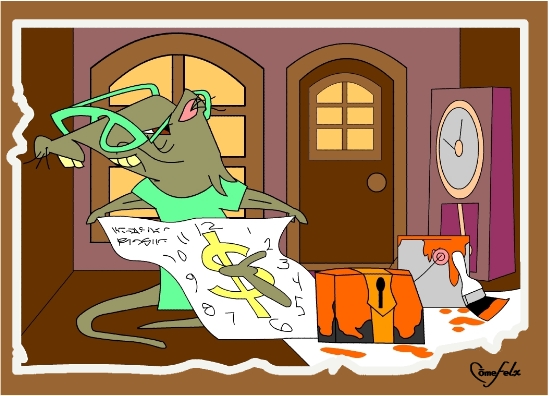
The old rat made himself up by dusting a little bleached flour over his skull. Deliberately delaying his entrance, he ran just enough to arrive out of breath. Then, as he presented himself to them, he apologized.
- “Honourable rats, I ask your forgiveness. But I had to catch up with some time that had evaporated from the box you see here.”
Without delay, he got to the heart of the matter. He spoke quickly, having planned that this would make the assembly a little dizzy. Persuasively, he led them to believe that everyone could benefit from captured time.
- “Even your death could be delayed!” he cried out. “All you need to do is store in this little scorched pulp box the time you do not use. Unfortunately, it is fragile, and time can escape. If it were made of gold, your future would be secure.”
- “We will provide you with all the gold you want. We can even build you a huge box, a great golden building to contain time, if you ask it of us!...”
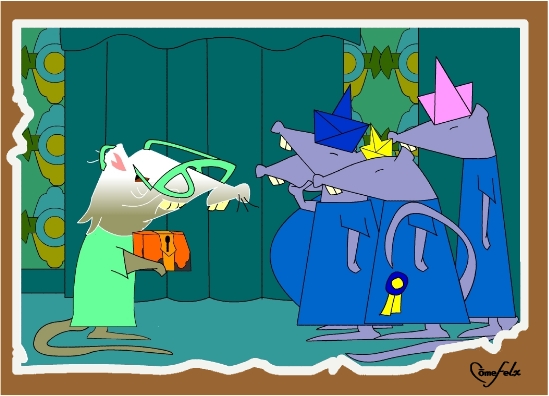
“But show us the principle first,” said one of the dignitary rats.
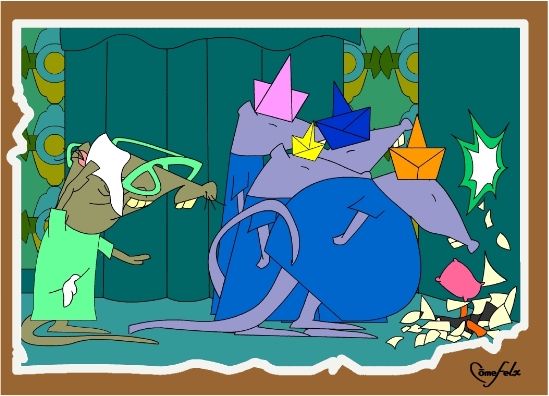
The old rat asked them to turn toward the wall behind them. Thus, no one saw him wipe the flour from his head after throwing down his fragile box, which shattered into a thousand pieces.
The quietest yet most observant of the notables noticed, among the debris on the floor, a tiny pink pillow.
- “Where did the time go?” one of the noble rats asked as he turned around. Then he added, “Don’t tell me—I can see it. You’ve grown younger!”
- “Indeed, I feel it too! The time I had saved partly returned to me, and the rest escaped. The loss was caused by the quality and fragility of the little box,” the old rat lied.
- “And why this little cushion?” some wise rats asked, pointing at it.
- “Time gets bored when it has nothing to do, and falls asleep. To attract it, you simply place a comfortable pillow in the box. Thus, the longer time sleeps, the more refreshed and rested it will be when needed. As for putting time into the box, it is simple. You need only do everything faster. It is the unused time that goes to sleep.”
All the rats had nothing but praise for the inventor.
Without delay, the whole kingdom got to work: noble rats, laboring rats, and even the unemployed. A gigantic golden box, as high as a mountain, was built according to the old rat’s plans. He had even managed to convince the kingdom’s leaders to build him a large lodge inside it so that he could live there. His argument was simple: he would watch over the time, make sure it did not escape, and count the minutes the box would capture.
For the construction, the kingdom took its time. Since time could not be stored anywhere except in a box invented by the old rat, there was no point in rushing.

On the day the time-trap was inaugurated, the old rat settled comfortably into his new golden quarters. All he did was rest, eat, and doze. Far too comfortable in this golden fortress, he cared only for himself and delighted in the memory of how he had deceived everyone.
Everywhere else in the kingdom, speed became an obligation. Everything had to go faster and faster, ever faster, in order to capture as much time as possible.
A new disease appeared in the kingdom: the absence of free time caused by this frantic speed. The rats no longer rested; they no longer slept. They wanted to save time. Everyone had to become quicker, more efficient. Work, decisions, games—everything had to be rushed through. Everything became so fast that no rat took time to live. They no longer knew the difference between happiness and misfortune, because they no longer had time to tell them apart.
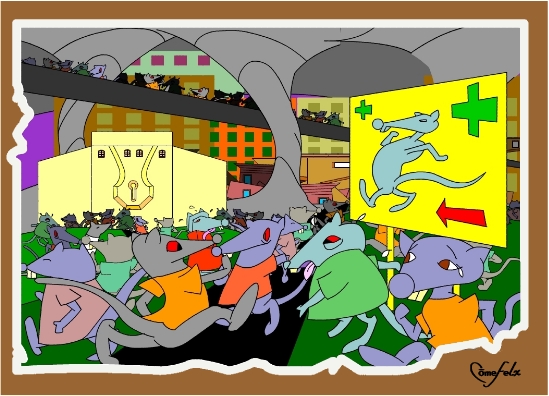
All the rats in the kingdom became so tense and nervous that they began killing those who were not moving fast enough. “That will only make more time for the remaining rats!” they told one another. And so they did the same to each other.
The last one—an ambitious rat who kept going faster and faster—died of exhaustion.
One day, when the old rat ran out of provisions, he decided to emerge from his cozy lair. He saw nothing but death and desolation, and understood the part he had played in the tragedy.
He would have liked to apologize. He had all the time in the world.
But he no longer could. The time of the other rats was over.