Once upon a time, in the infinite land of dreams, there was a little fisherman named Jacko. Jacko fished mainly in the large lake in front of his house, a lake that in the morning looked like a mirror.
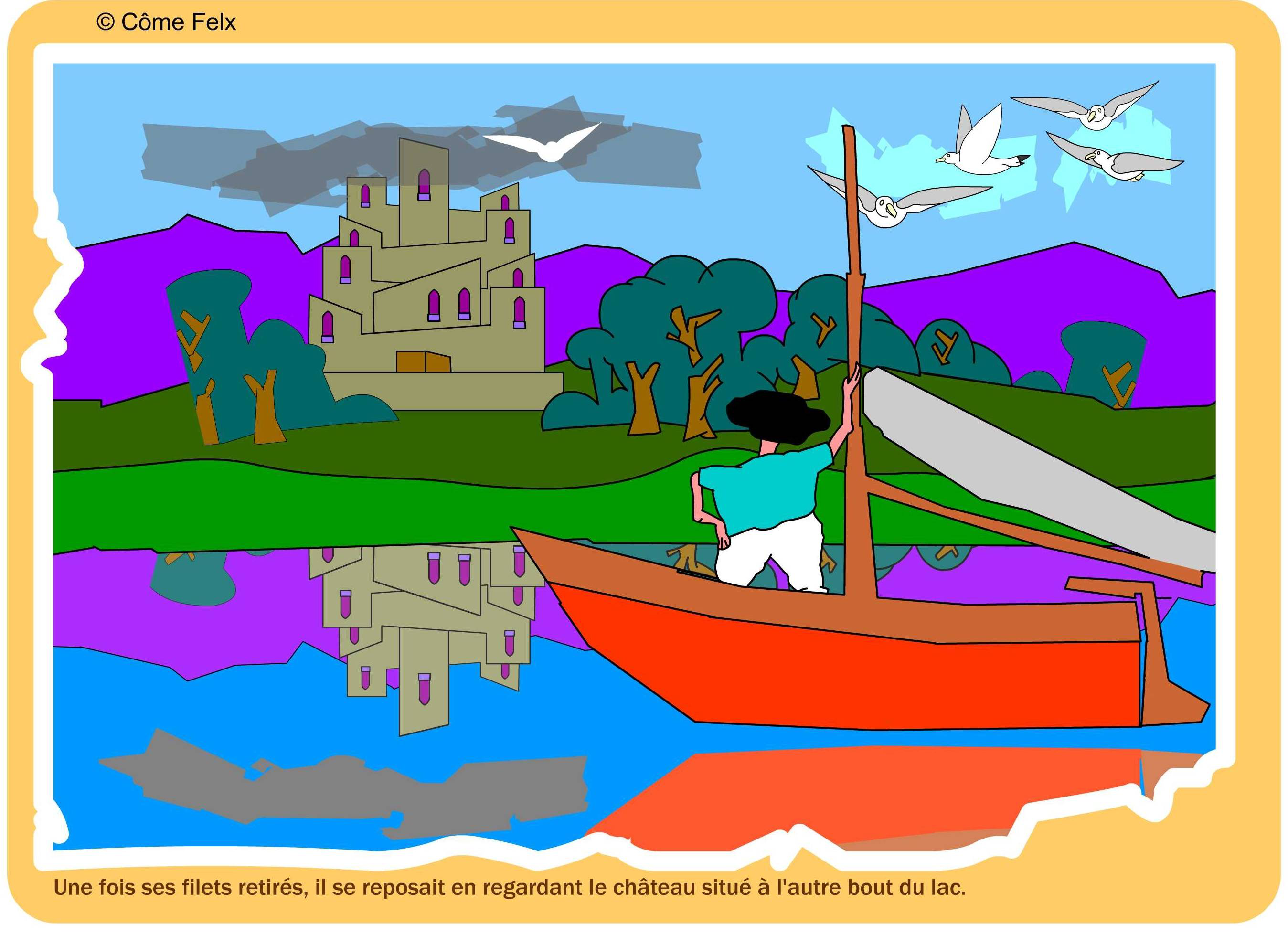
Jacko also loved the strong winds that made the waves rise, as if the breath of the sky were drawing them upward. And once he had pulled in his nets, he would rest while gazing at the castle on the other side of the lake. Recently, it had been nicknamed “the castle of the unreachable people.”
It owed this reputation to Rostre the sorcerer and his voracious wolf, who blocked all access to the castle. No one went in. No one came out.
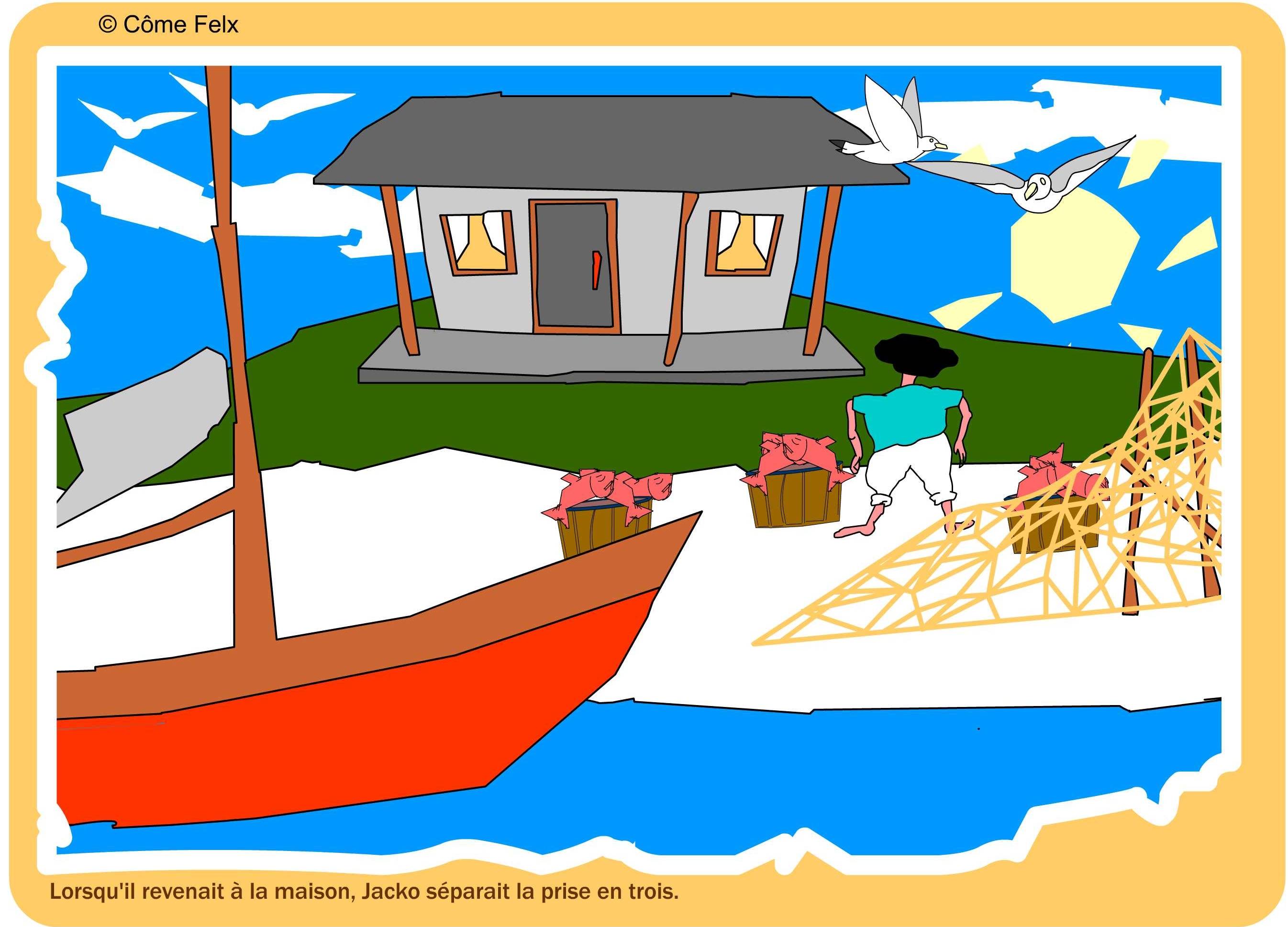
When he came home, Jacko divided the catch into three parts: one for the market, one for his meal, and the third for a mixture of secret herbs.
The recipe was perfect! For any stomach, large or small, resistance to pamplito was futile. What a funny name Jacko had chosen for that mixture of fish and herbs!
Jacko never ate pamplito. He prepared it to catch seagulls.
When a seagull was trapped in the cage, Jacko would talk with it. For a few minutes, it became his forced confidant.
First he would talk about fishing, poetry, and a little bit of everything. Then he would invent stories about those unreachable people living in the castle. Once the session was over, before releasing the bird, he would reward it with a piece of bread spread with honey.
But one day, he caught a seagull that seemed more hostile than the others.
For her, he made an exception and told only fantasies about the people of the castle. The fierce bird inspired nothing else in him.
The seagull, which had been violently pecking at the bars of the cage, suddenly stopped. Jacko had never had a more attentive listener. But the fisherman failed to notice this detail and ended the series of stories by releasing the bird.
The next day, the wild gull was back. Chasing away the other birds with a single sweep of her wing, she cried out for attention. The seagull seemed eager to make her own capture easier!
Jacko smiled, for he thought the animal was becoming tame. So he offered the seagull a little pamplito and even some honeyed bread.
Then he invented new tales for the daring little creature.

No longer trying to escape, the seagull listened carefully to her jailer. That night, Jacko felt inspired. He invented thirty-six stories. It was probably too many. The little fisherman, exhausted, went home to bed and forgot to release the bird.
In the middle of the night, Jacko heard crying and complaints that troubled him. He stayed where he was, thinking it was only a bad dream.
At daybreak, he noticed that the bird was still trapped in the cage. He opened the door and took the seagull out. The bird looked at Jacko without flying away. Then, with her beak, she wrote these words on the sand.
- “Lock me up! Watch the coming night with me.”
Somewhat surprised, he obeyed the bird and put her back in the cage.
Fishing was poor. He was thinking too much about the bird that could write. Jacko returned with only one fish, for himself and for the seagull who was waiting for him.

Jacko prepared to spend the night. He lit a fire and invented thirty-six more stories about those unreachable people.
- “It’s crazy to spend the night with a bird that can write!” he would regularly comment between stories.
Night had only just fallen when an extraordinary metamorphosis took place. The seagull turned into a beautiful young woman.
- “Please open the cage door. It is far too narrow, and I am hurting myself,” said the nobly dressed young woman in a firm voice.
He opened it for her. A thousand questions raced through Jacko’s mind. Too dazzled, he could only remain silent.
- “I am Marie-Anne, and I live in the castle on the other side of the lake,” she continued, stepping out of the narrow prison.

- “I am Jacko, and I am of no importance if you truly live there.”
- “Of no importance? Oh no! No! Your talent as a storyteller has placed a balm upon my saddened soul.”
- “You are as beautiful as the daytime sky. By what magic do you fly there as a seagull?”
- “Rostre, that old wizard! It is his witchcraft! Rostre wanted my father, the king, to give him my two sisters and me as apprentices and wives. My father categorically refused. So Rostre put a spell on us.
Every morning, we turn into birds, each a different kind from the others. He feared we might share the same cry! And when night falls, once we recover our human bodies, he turns into a huge wolf and prevents us from leaving the castle to seek help.
Even in bird form, escape is impossible, because our instinct always brings us back to the castle, to our nest,” Marie-Anne concluded.

Then she added, looking at the firelight flickering across the fisherman’s face: “I knew that by writing on the sand, you would not try to sell me to a fairground.”
That confession, being not unlike one of his own tales, quickly gave Jacko an idea.
- “I must go to bed so that tomorrow’s fishing will be good,” he said, smiling at Marie-Anne. “...I invite you to enter my humble home. In the shape of a seagull, I hope you won’t be afraid. My little house is the biggest cage I have.”
A few hours later, Jacko was singing under the sun as he hauled in his first fishing nets. Never before had he been so skillful and lucky. He had caught so many fish during the day that he struggled to bring his boat back to shore.
Marie-Anne would have helped the fisherman, but, as expected, the feathers had returned... Princess Marie-Anne... would not return until nightfall.

He brought back so many fish that he prepared the pamplito directly in the boat. Then he shaped the whole mixture into little human silhouettes. It looked like a giant platter of tiny people.
Jacko had just enough space left to sail. Only two well-filled bags of the same mixture were beside him.
With his sail hoisted and his knowledge of the lake, he set out fearlessly through the night. The wind was blowing just as Jacko had hoped. No danger hindered the crossing.
Once moored not far from the castle, he grabbed both bags. He took a few steps, then stopped to take out some pamplito. He shaped it into the figure of a little seated man.
A little farther on, he did the same again. Each portion looked like a tiny human being; it was like a line of little goblins gazing up at the stars.

- “So many good little cakes to help the castle,” Jacko thought.
When he came near the ramparts, he covered himself with pamplito. He coated himself so thoroughly that the wolf, who had just spotted him, suddenly found him deliciously appetizing.
- “How good you smell, little man!” said the wolf to Jacko. “I think I am going to eat you!”
- “Eat me?” Jacko replied. “I hope you will spare me, my little brothers, and those in the boat below.”
The wolf, already running toward him, was surprised to see his prey disappear so quickly. Jacko, alert and ready, ran before the beast’s claws could seize him.
As the wolf approached, there was always an irresistible pamplito cake to slow him down. Just like the seagulls—and like men—no wolf could resist the smell and taste of Jacko’s delightful trap.

The more the wolf stopped to stuff himself with pamplito, the farther Jacko got away. Jacko fled, while the beast could see only the tempting feast filling the boat. Jacko waited for the trap to close.
The wolf devoured everything in one sitting.
Just as Jacko had foreseen, the wolf ate too much, and the boat became a bed for the glutton. In less than two minutes, the silence of the night was broken by loud snoring.
Taking advantage of the wolf’s sleep, Jacko guided his boat to the middle of the lake, where it was deepest.
He took a spike and pierced the hull. Water quickly rushed into the boat. It sank swiftly, dragging the wolf—too stupefied to struggle—down into the depths of the lake.
Jacko swam toward a light coming toward him. It was Marie-Anne, rowing a small boat in his direction.

They both hurried home before dawn. Jacko feared that Marie-Anne would fly back to the castle in the shape of a bird.
The sun rose, making the lake shine and illuminating Marie-Anne’s ravishing face, which remained entirely human.
Without delay, they turned back and headed toward the castle. This time, Jacko rowed the whole way.
Halfway across, at the place where the wolf had drowned, something surprising caught their attention. Rostre the sorcerer’s clothes were floating where Jacko had sunk the boat.
Jacko noticed stains on the clothes and bent down to smell them. Then he burst out laughing.
- “Why are you laughing?” asked Marie-Anne.
- “If by day you became a seagull, then by night Rostre became a wolf. And I laugh with pride, because no one can resist my pamplito. Not even wicked sorcerers!”
When she arrived at the castle, she once again found the members of her family running about in search of her. They were no longer the wizard’s victims, now that he had drowned. Marie-Anne introduced them to Jacko and explained how he had helped them.
A few days later, the King and his loved ones invited everyone to a great feast. On the menu: a wedding cake, a delicious pamplito, and Prince Jacko’s fairy tales about the castle of the welcoming people.