If you're willing to put in a little effort... this game is free. The images are in A4 format and have cutting guides. Save them in a folder, print them, and play. This game must not be sold. If it is sold, the seller is responsible for paying the copyright royalties due. I am not responsible for printing costs or for any consequences arising from printing.
INTRODUCTION
The game consists of 173 different cards. It can be played in a group or alone. There is the regular ONIROO mode (group play) and ONIROO SOLITAIRE. The aim of the game is to invent and build DREAMS.
OBJECT OF THE GAME: be the first player to complete one or more DREAMS made up of SYMBOL cards (D) and/or FREE cards (E), then place the WAKE-UP card (J) in front of all the players to be declared the winner.
To make the game easier to learn, there are 5 difficulty levels, from the simplest to the most complex.
For 2 to 6 players in group play.
For 1 player (ONIROO SOLITAIRE, section N).
TABLE OF CONTENTS
A. CONTENTS
B. PREPARATION
C. GAMEPLAY (5 difficulty levels)
D. SYMBOL card (130 different cards)
E. The FREE card (8 different cards)
F. ASSOCIATION OF GROUPS AND CODES
G. BAD NIGHT cards (3 different negative cards)
H. MOON HEAD cards (5 different negative cards)
I. DREAM FAIRY cards (5 positive-value cards)
J. WAKE-UP card (1 card)
K. DREAM FORMATION
L. DREAM DESCRIPTION
M. OPTIONAL: DREAM VOTE
N. ONIROO SOLITAIRE (with 21 MAGIC CODE cards)
Note: A DREAM is made up of SYMBOL cards and/or FREE cards, the latter having no image. These cards are placed face up in front of a player or in the centre of the table (see C_01 and C_02).
- A player may have several DREAMS at the same time.
- The first card played in the DREAM (SYMBOL card and/or FREE card) is chosen by the player.
- A DREAM is completed with a variable number of cards. All that is missing for this DREAM to become a winning one is... the WAKE-UP card (see J).
- Points are recorded for each game.
- The player with the most points is the overall winner.
CONTENTS
A_01: There are 130 SYMBOL cards, which are the components of your DREAMS. They are all different.
Notice the black symbol in the yellow rectangle. It completes the illustration in the centre of the card (see D). It identifies one of the groups in the game. The markings on the left side of the card are codes: red for letters (A to F), green for shapes (SQUARE, STAR, etc.), and blue for numbers (0 to 9).
These codes are called MAGIC CODES (see D).


A_02: There are 8 FREE cards. No group is indicated in the yellow rectangle.
In this case, the yellow rectangle can represent any group.
However, like SYMBOL cards, FREE cards also have a group indicated in the purple circle.
They contain all the MAGIC CODES (letters, shapes, and numbers in the white rectangle), arranged to form a kind of U.
These cards have no image (see E).

A_03: 1 WAKE-UP card. It can determine the winner of the game.
Some ways of playing do not involve the following elements:

A_04: 3 BAD NIGHT cards
Cards with a negative value, marked with a question mark.
The question mark is used to distinguish this type of card (see G).

A_05: 5 MOON HEAD cards
Cards with a negative value, marked with a question mark.
The question mark is used to distinguish this type of card (see H).

A_06: 5 DREAM FAIRY cards
These cards protect the player.
Cards bearing an at sign (@) in a white rectangle are DREAM FAIRY cards (see I).
The at sign (@) is used to distinguish this type of card.
PREPARATION
For new players: place one card from each category on the table to help you understand how they work.
B_01: Shuffle all the cards used for the chosen level.
Deal 5 cards to each player.
Players must end their turn with 5 cards in hand. If a card effect or playing several cards changes this number, they draw from the SOURCE PILE or discard excess cards into the DISCARD PILE until they have 5 cards again, unless otherwise indicated.
These cards must not be seen by the other players, except in certain cases (see below).
In particular, some MOON HEAD cards are exceptions to this rule.
B_02: Leave the remaining cards face down on the table. You may form two piles, both called the SOURCE PILE.
B_03: During the game, discarded cards are placed face up. They form a pile called the DISCARD PILE.
The SOURCE PILE and the DISCARD PILE are placed in the centre of the table.
Players do not draw from the DISCARD PILE.
B_04: On their turn, the player draws a card from the SOURCE PILE.
They may play this card, place it in the DISCARD PILE, or keep it in their hand.
B_05: At the beginning of the game, when the chosen level allows it, the players decide whether or not to use the FREE cards (see E).
Play proceeds clockwise, from left to right.
HOW TO PLAY
There are several ways to play, from the simplest to the most complex.
LEVEL 1
C_01: Level 1 is the simplest.
At this level, players do not need to worry about MAGIC CODES or groups.
Players do not use BAD NIGHT, MOON HEAD, or DREAM FAIRY cards.
On their turn, each player must place a SYMBOL or FREE card face up in front of themselves.
Each player must try to accumulate at least 10 SYMBOL and/or FREE cards.
The player who completes a DREAM of at least 10 SYMBOL and/or FREE cards, then places the WAKE-UP card, wins the game. This earns 5 points.
LEVEL 2 — A SHARED DREAM
C_02: At this level, players do not need to worry about MAGIC CODES or groups.
Players do not use BAD NIGHT, MOON HEAD, or DREAM FAIRY cards.
Players take turns placing a SYMBOL or FREE card in the centre of the table.
The aim of this level is to create a single DREAM shared by all players.
Each player must place a SYMBOL or FREE card face up as part of the shared DREAM being built.
Optional: players may explain their choice of card, whether it is a SYMBOL card or a FREE card.
This shared DREAM must contain at least 10 SYMBOL and/or FREE cards.
The player who places the WAKE-UP card wins the game. This earns 5 points.
LEVEL 3
C_03: Players take MAGIC CODES (letters, shapes, and numbers) and groups into account, as explained below.
They use all the cards except FREE cards and those on which the sleeper is wearing white pyjamas.
On their turn, each player must place a SYMBOL card in the shared DREAM, unless they play a special card permitted at this level.
This SYMBOL card must remain face up so that everyone can see the image and the codes.
The player who completes the DREAM of 10 SYMBOL cards and places the WAKE-UP card wins the game. This earns 10 points.
1) If a BAD NIGHT card is placed on the DREAM pile, each of the other players must wait two turns before being able to place a new SYMBOL card in the DREAM in progress. This penalty does not apply to the player who placed the BAD NIGHT card.
2) A DREAM FAIRY card cancels the effect of the BAD NIGHT card.
LEVEL 4
Level 4 is played like Level 5, except that the players choose to use either BAD NIGHT cards or MOON HEAD cards.
LEVEL 5
C_04: Players take MAGIC CODES (letters, shapes, and numbers) and groups into account.
The black graphic in a yellow rectangle or a purple circle is called a group (see D).
They use all the cards except those on which a little dreamer is dressed in white.
C_05: Each player must create their own DREAM.
The player must create a DREAM of at least five SYMBOL and/or FREE cards. This DREAM consists of a series of SYMBOL and/or FREE cards that meet the MAGIC CODE and group criteria.
C_06: The game is played in two phases.
- The first is the creation of DREAMS.
- The second, which is optional, is a vote on a DREAM (see M).
- One player is chosen to begin the game.
- The five cards in a player's hand must be kept hidden from the other players, except when certain negative-value cards take effect.
- A player must always have five cards in hand at the start of their turn.
- On their turn, a player must always draw a new card before playing.
- If the players exhaust the SOURCE PILE, the DISCARD PILE is shuffled. These cards are then placed face down on the table. They form a new SOURCE PILE and the game can continue.
C_07: As the game progresses, the player must place SYMBOL or FREE cards in front of themselves, following the rules for matching codes and groups (see F).
They place their card when their turn comes.
The player freely chooses the first card they place, whether it is a SYMBOL card or a FREE card.
A player may place more than one SYMBOL and/or FREE card during the same turn if they have a valid group association in their hand (see below).
The game ends when a player places the WAKE-UP card after completing their DREAM. This type of Level 5 victory earns 15 points.
If they complete another player's DREAM by placing the WAKE-UP card on that DREAM, they earn 5 points.
If the players wish, there may be a vote (see M).
The SYMBOL card
Players' DREAMS are formed from the illustrations in the centre of the SYMBOL cards.
See the examples.
These cards also include:
D_01: Numbers from 001 to 130 are used to number the images.
They should not be confused with the numerical codes located to the left of the yellow rectangle.
There are also letter codes, shape codes, and numerical codes.
These codes are used to build DREAMS at Level 5.
Groups are also used to structure DREAMS.
All these elements are used to form DREAMS.
The group identified in the yellow rectangle mainly indicates the category represented by the image. In the example, the diamond belongs to the group for the mineral kingdom and objects.
The group indicated in the purple circle identifies the group required for the next card: that card must match this group in its yellow rectangle.
There are 8 different groups: 1: the animal kingdom; 2: the plant kingdom; 3: objects or the mineral kingdom; 4: places (habitats); 5: human beings; 6: works of imagination, history, myths, and legends; 7: landscapes or events; 8: energy.
D_02: Reminder: the illustrations are used to describe DREAMS.
E_01: The FREE card
Like the SYMBOL card, the FREE card allows group associations.
However, it retains the group indicated in the purple circle.
The graphic in the purple circle therefore makes these group associations possible.
This card contains all the MAGIC CODES. They are arranged in a U shape on the white surface of the FREE card.
It can replace or supplement any SYMBOL card.
You may draw, paste an image, or write on this card. It allows you to add SYMBOLS, actions, or states other than those depicted in the illustrations. The aim is to add elements you would like to see in your DREAMS.
You do not have to use these cards, and you need not use all of them. This decision must be made before the game begins.
These cards are shuffled together with the other cards at the beginning of the game.
A FREE card is played like a SYMBOL card and can also be used to form DREAMS.
Exception: a player whose winning DREAM is made up entirely of 7 FREE cards earns 20 points. In this case, the WAKE-UP card is not required to win.
ASSOCIATION OF GROUPS AND CODES
F_01: At Level 5, to win, the player must have a series of codes as well as one or more group associations.
F_02: Group association: players must match the group indicated in the purple circle of a SYMBOL card (or FREE card) with the group indicated in the yellow rectangle of the next SYMBOL or FREE card placed in their DREAM.

These are often cards with consecutive numbers. For example: card 020 (first card) and card 021 (second card).
F_03: The DREAM must contain a minimum of 5 SYMBOL and/or FREE cards. Players may also increase this minimum before the game begins.
F_04: A player may complete another player's DREAM. However, the WAKE-UP card is required (5 points).

F_05: Combining codes to form a DREAM: in your DREAM, you must have 5 SYMBOL and/or FREE cards bearing the same letter code: A, B, C, D, E, or F. You must also have created one or more group associations.
Your DREAM is now complete. All that is missing is the WAKE-UP card.
F_06: Another possible code association: you must have 5 identical shape codes in your DREAM — triangle, square, circle, star, or cross — as well as one or more group associations.
This gives you another kind of DREAM.
All that is missing is the WAKE-UP card.

You will notice that the numerical codes do not necessarily follow a logical order on the cards. That would have been too easy.
F_07: Third code association: you must have 5 consecutive digits in your DREAM: 1, 2, 3, 4, 5 or 6, 7, 8, 9, 0. Descending order is also allowed, for example 5, 4, 3, 2, 1. Your DREAM must also contain one or more group associations.
You now have a complete DREAM.
The only thing missing is the WAKE-UP card.
F_08: You may include FREE cards in your DREAM.
BAD NIGHT cards (negative-value cards): these cards show DREAMERS in orange, purple, or green pyjamas.
G_01: A player who has one of these cards may play it against any other player when their turn comes.
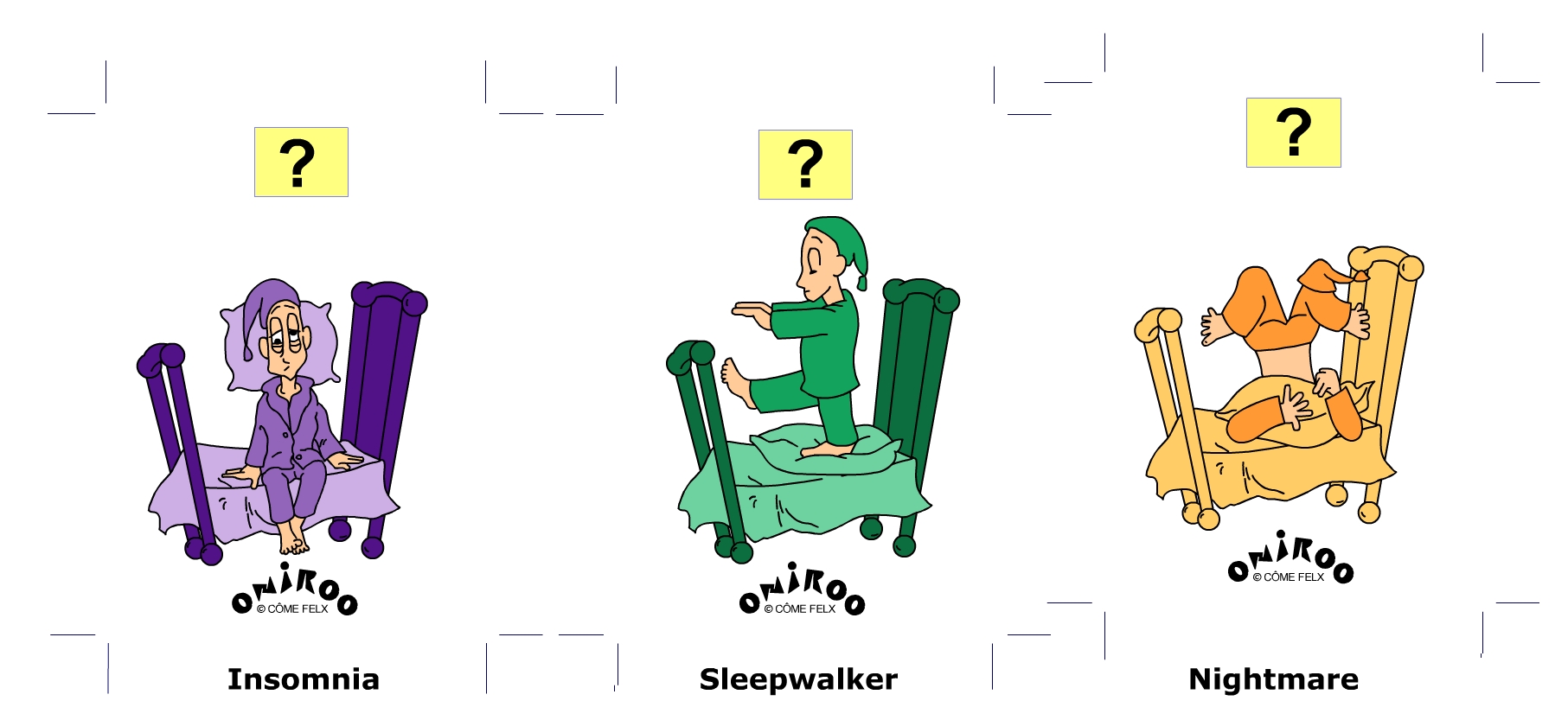
The player may choose when to play these cards.
G_02: A player who plays a BAD NIGHT card may not play another card during the same turn.
The player who plays a BAD NIGHT card does not suffer its penalty. They impose it on another player.
G_03: Once a BAD NIGHT card has been played, it is immediately placed in the DISCARD PILE.
DETAILS AND CONSEQUENCES:
G_04: NIGHTMARE card (orange pyjamas)
The player targeted by the attack must place their current DREAM in the DISCARD PILE.
They keep the cards in their hand.
G_05: SLEEPWALKER card (green pyjamas).
The targeted player replaces all the cards in their hand but keeps any DREAMS already in progress.
They place all the cards in their hand in the DISCARD PILE, then draw 5 new cards from the SOURCE PILE.
G_06: INSOMNIA card (purple pyjamas):
The attacking player draws one card from the hand of each of the other players. They place any cards they do not wish to keep in the DISCARD PILE.
The targeted players then each draw one card from the SOURCE PILE.
Players must always have 5 cards in hand.
MOON HEAD cards (negative-value cards):
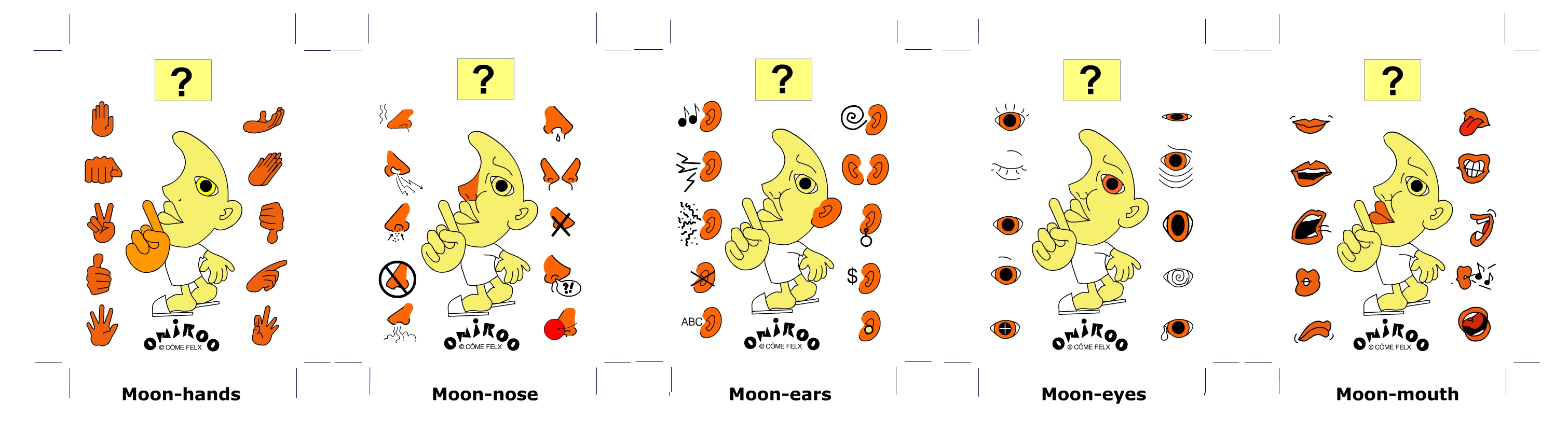
H_01: MOON HEAD cards are identified by a yellow character with a crescent-moon-shaped head, wearing slippers and a white nightgown.
On each of these cards, one of the senses is highlighted in an orange-red colour: smell, hearing, touch, sight, or taste.
This is a penalty card that can be played only once, unless it is drawn again.
When a player is attacked with a MOON HEAD card, they must accept the penalty associated with the sense shown on the card.

H_02: Coloured eyes (MOON EYES):
On their next turn, the targeted player must play one card from their hand without looking at the cards. If they have memorized their hand, they may try to choose a card whose effects they know. For example, they may play a BAD NIGHT card themselves.
H_03: Coloured hands (MOON HANDS):
The targeted player discards as many cards from their hand as there are other players.
They then draw the same number of new cards from the SOURCE PILE.

H_04: Coloured ears (MOON EARS):
The other players receive the attacked player's DREAM cards. They may add them to their hands or to their own DREAMS, or place them in the DISCARD PILE. If the attacked player has no DREAM, the card has no effect.

H_05: Coloured mouths (MOON MOUTH):
When the attacking player shows everyone the MOON HEAD card with coloured lips, each player passes their hand to the player on their left.
The attacking player decides whether or not to take part in this exchange.

H_06: Coloured noses (MOON NOSE):
The attacked player gives the attacker one card from their DREAM. The code matching must remain valid. If removing this card breaks the code matching in the DREAM, the attacked player must remove cards from that DREAM back to the position previously occupied by the removed card.
H_07: Once used, the MOON HEAD card is placed in the DISCARD PILE.
H_08: REMEMBER: PLAYERS MUST ALWAYS HAVE 5 CARDS IN HAND, EXCEPT WHEN ONE OF THEM PLACES THE WAKE-UP CARD TO END THE GAME.
The DREAM FAIRY card
I_01: The player holding this card is protected against BAD NIGHT and MOON HEAD cards.
The player simply has to show this card to defend themselves against an attack.
The attacking player loses 5 points if they have points to deduct.
I_02: Once used, DREAM FAIRY cards are placed in the DISCARD PILE.
I_03: A player who manages to collect 5 DREAM FAIRY cards in their hand immediately wins the game and earns 15 points.
The WAKE-UP card
J_01: The game ends when a player places the WAKE-UP card.
The WAKE-UP card is the one whose clock face shows 07:00.
J_02: A player must wait for their turn to play the WAKE-UP card.
J_03: The player who places the WAKE-UP card must have at least one completed DREAM.
J_04: A player who has the WAKE-UP card may also use it on another player's completed DREAM (5 points).
DREAM FORMATION
K_01: To begin a DREAM, each player places a SYMBOL or FREE card of their choice in front of themselves.
As the game progresses, players complete this DREAM by following the rules for MAGIC CODES and group associations.
They may also form a DREAM with the cards accumulated in their hand and reveal it at the last moment by placing all those cards on the table. They then draw 5 new cards from the SOURCE PILE.
K_02: A player may place more than one SYMBOL and/or FREE card in their DREAM at the same time.
A player may have more than one DREAM.
If there are no cards available in either the SOURCE PILE or the DISCARD PILE, the game is a draw.
The player with the most points at the end of the game is the winner.
DREAM DESCRIPTION (optional)
L_01: If everyone agrees, the winning player describes the DREAM using their cards. They may also interpret it as a psychoanalyst might.
They describe this DREAM in their own way, as a story. They may recite, mime, sing, or use any other form of expression depending on their interests.
OPTIONAL:
DREAM VOTE
M_01: The players combine the DISCARD PILE and the SOURCE PILE, then shuffle all the cards.
M_02: Each player draws a card. The player who draws the card with the highest number earns 5 points. The winner of the game may also participate.
If the number on the card drawn by the winner of the game is higher than those on the cards drawn by the other players, they earn an additional 10 points.
The image on this card becomes a symbol of the way the winning player played the game.
And if you feel like it... you can start dreaming again... by playing another game.
M_03: Together, the players may imagine the story of the DREAM made up of the cards used for the vote.
SCORE SHEET
M_04: Here is an example of a score sheet for keeping track of your points.

ONIROO SOLITAIRE
N_01: THE CARDS:
DREAM FAIRY cards protect you against BAD NIGHT and MOON HEAD cards, which of course do not have the same effects in solitaire mode. A DREAM FAIRY card placed in your playing area remains there until the DRAW PILE is exhausted or until it is used according to the rules below.
When you have a DREAM FAIRY card, place it beside the MAGIC CODE cards you have chosen and placed in your playing area. You may have two DREAM FAIRY cards on the table.
N_02: Two DREAM FAIRY cards cancel the effects of BAD NIGHT and MOON HEAD cards.
Two DREAM FAIRY cards also protect you from the WAKE-UP card when it is drawn at the wrong time.
However, once this protection has been used, you must place both DREAM FAIRY cards in the DISCARD PILE.
If you are not protected by two DREAM FAIRY cards, drawing a BAD NIGHT or MOON HEAD card forces you to return all the cards in your hand to the DRAW PILE, even if those cards would help you.
MAGIC CODE CARDS: These cards determine the direction of play. They are used only in ONIROO SOLITAIRE.
LETTER CODE: A, B, C, D, E, F.
SHAPE CODE: SQUARE, CIRCLE, CROSS (+), STAR, TRIANGLE.
NUMBER CODE: 0 to 9.


Shuffle your cards. Hold your deck in your hand or place it face down on the table.
You may divide your deck into two piles to make it easier to handle.
Draw two cards at a time. Look at the first card before considering the second. You may consider the second card only if you have successfully played the first.
WAKE-UP card: the game stops as soon as this card is drawn, unless you are protected by two DREAM FAIRY cards (see N_02).
Levels 1 and 2 of ONIROO SOLITAIRE are played without FREE cards.
LEVEL 1 — ONIROO SOLITAIRE
Among the MAGIC CODE cards, use only the number cards. Also use the SYMBOL cards and the special cards specified in N_01.
Draw a SYMBOL card from your DRAW PILE. The number shown on the card indicates the digits you must find to complete the challenge. For example: 067, the bridge. You must then find the digits 0, 6, and 7. This increases the level of difficulty.
If you do not have two DREAM FAIRY cards to counter the WAKE-UP card, the game ends as soon as the WAKE-UP card is drawn.
LEVEL 2 — ONIROO SOLITAIRE: in a way, the reverse of Level 1. Find a SYMBOL card whose number corresponds to three numerical MAGIC CODES.
First, find the MAGIC CODES that suit you.
Do not use FREE cards or letter and shape MAGIC CODES.
Draw cards two at a time until you obtain a numerical MAGIC CODE card, that is, a card with a digit and a little sleeper.
You may place the NUMBER CODES in any order you choose. The chosen order remains the same as you work through the pile.
Example: you have managed to place the digits 0, 5, and 8 in front of you despite the BAD NIGHT and MOON HEAD cards. You must now find card 058. In this case, it is the night sky.
N_03: The game ends either when you complete the challenge or when the WAKE-UP card is drawn and you are not protected by two DREAM FAIRY cards.
If you need a repeated digit, for example in 22, take any card you draw and place it face down beside your number code. This card represents the repetition of the same digit.
LEVEL 3 — ONIROO SOLITAIRE
LEVEL 3 OBJECTIVE: try to obtain all three types of MAGIC CODES and the SYMBOL card corresponding to those three MAGIC CODES. This must be done before drawing the WAKE-UP card, despite the negative-value cards.
Play with all cards except FREE cards; you may add the FREE cards if you wish. It will be easier, because all types of codes are represented on them.
If you draw a MAGIC CODE card — bearing a numerical code from 0 to 9, a letter from A to F, or one of the following shapes: STAR, SQUARE, CIRCLE, CROSS, or TRIANGLE — place it in front of you if it matches your choice.
During Level 3 of ONIROO SOLITAIRE, try to match the three types of MAGIC CODES with the codes on a chosen SYMBOL card. If you draw another MAGIC CODE card, you may replace a card only with one of the same type: letter for letter, digit for digit, shape for shape.
Try to obtain a SYMBOL card that matches the three codes you have placed on the table. For example, the letter code A, shape code CROSS (+), and number code 5 correspond to card 023, the centaur.

Oniroo